Understanding Coffee Culture Around the World
By the QuiteRecipes team (Jamy & Kaïna)
Coffee is culture in a cup. How espresso rules in Rome, Turkish kahve is made and read, Japanese kissaten slow down, and how to drink each right.
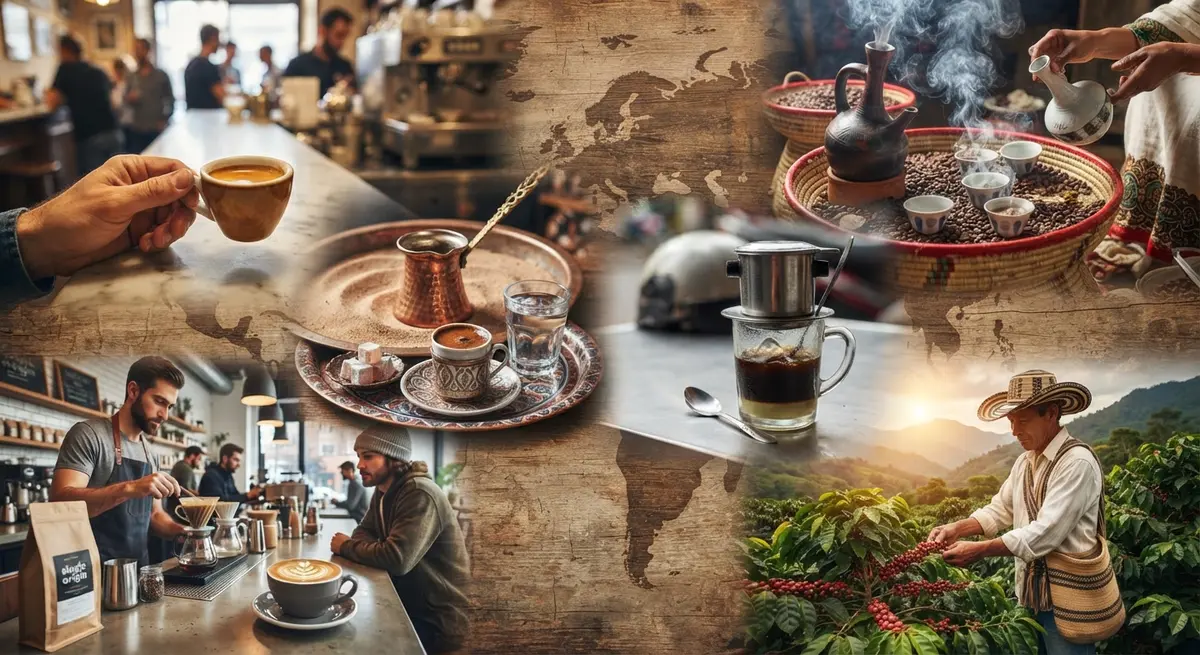
I once stood at a Neapolitan bar counter at 7:40 a.m., money already on the register, and watched the man beside me drink an espresso so quickly it could have been a vitamin. He handed back the tiny cup, nodded to the barista, and disappeared into the street. Nobody said a word. That morning I understood what no airport coffee shop has ever explained: coffee isn't a product here. It's a liturgy, a social clock, a small daily ceremony performed by a city in perfect unison.
Every culture does coffee differently, and the differences are not fussiness — they're the whole point. Turkish kahve with its grounds and ritual. A Japanese kissaten where a slow drip is an hour of attention. Vietnamese iced coffee treating milk as a canvas. Nordic pour-over turned into a national meditation. Learning to read these cups is learning to read the people holding them. Here is my traveler's guide to the world's coffee cultures, and how to drink each one the way you'd want to be greeted.
The Italian Espresso: Small, Standing, Social
Italy's coffee culture runs on a few conventions a visitor should know:
- It's drunk standing. The bar at the counter is for the quick hit; sitting at a table adds a service premium locals quietly avoid. Pay at the register first, hand the receipt to the barista, drink, and go — the whole ritual takes ninety seconds.
- Size means one thing. Order "un caffè," or "macchiato" if you want a stain of milk. Ask for a larger coffee and you'll get a cappuccino or a latte — coffee's dessert, not its espresso.
- Milk stops at midday. A cappuccino after 11 a.m. marks the tourist; locals drink espresso after that. It's not snobbery — it's digestion, temperature, and habit in one small cup.
Pro tip: In Italy, don't ask for "espresso" — order "caffè." And standing at a busy Roman bar isn't rudeness; it's the point of the place.
Turkish Coffee: Grounds, Fortune, and Patience
Turkish coffee is the opposite of the standing espresso — slow, ceremonial, social:
- Brewed, not filtered. Finely ground coffee is boiled in a cezve with water and sugar to taste, then served with the grounds still settling. The foam, or kaymak, is the mark of a proper brew.
- Sweetness is decided, not offered. Sade (no sugar), orta (medium), or şekerli (sweet) — you announce it before the pot hits the stove, because sugar goes in during the boil.
- The grounds are read. Finish, leave the wet grounds in the cup, invert it to drain, and the patterns become material for fortune-telling — a whole tradition that follows the cup.
- It's for company. Turkish coffee comes with water and often a piece of lokum; nobody drinks it standing at seven in the morning. It belongs to living rooms and long afternoons.
Pro tip: If you're offered Turkish coffee, accept it and drink slowly, stopping just above the sediment. Asking for your cup to be read afterward is a friendly, memorable way to end the ritual.
Japan's Kissaten: Coffee as Contemplation
Japan developed a coffee culture so precise it's almost architectural:
- Slow and hand-brewed. Many kissaten serve a single-origin cup made by hand-drip — a gooseneck kettle, a thin stream, several patient minutes. The process is the point.
- The service is ceremonial. The room is hushed, and the cup arrives finished, often on a tray with a small glass of water. Silence is the correct sound of the room.
- The menu is particular. Some kissaten pour from a list of single origins with tasting notes like a boutique wine list. What you're buying is attention.
Pro tip: In Japan, arrive without rush, order the single-origin hand-drip, and sit to enjoy it. That hour of watching water and a steady hand is the coffee.
Vietnamese Iced Coffee: Milk, Ice, and Energy
Vietnam is the world's second-largest coffee producer, and it reinvented how coffee can taste. The iconic ca phê sữa đá — strong dark roast dripped slowly through a phin onto condensed milk, then stirred over ice — is sweet, strong, and deeply satisfying. The egg coffee of Hanoi, ca phê trứng, tops strong coffee with a silky froth of whipped yolk and condensed milk. Coconut and yogurt coffees continue the theme: milk and cream are partners, not compromises.
Pro tip: Order a ca phê sữa đá — and egg coffee if you're in Hanoi — and let the phin drip slowly rather than stirring it all into the ice at once.
Northern Europe: Coffee as a National Break
In Sweden, Norway, and Finland — the world's most coffee-hungry countries — coffee became a scheduled act of slowness. Fika, the Swedish word for coffee with company, is a national institution: the mid-afternoon pause with a cinnamon bun and a few friends, baked into the working day. The Nordic cup is light and clean, prized for bright, balanced roasts that taste of fruit rather than burnt caramel, brewed with the precision of a science. In Finland, coffee breaks are a right, not a splurge.
Pro tip: Order whatever single-origin the pour-over barista recommends, and drink the first cup without milk. Nordic coffee will teach you that light and balanced isn't a compromise — it's a decision.
How to Read the Cup and Order With Confidence
Under all the traditions, a small toolkit makes the difference between a good coffee and a cultural misfire:
- Learn the local word. "Caffè," "kahve," "kawa" — naming the cup in the local idiom changes the service you get.
- Mind the milk clock. In the Mediterranean, milk means morning; espresso follows. In Turkey and much of the Middle East, the coffee arrives sweetened and unfiltered — accept without surprise.
- Mirror the tipping. In the US, tipping your barista is standard. In most of Europe and Asia it isn't; Italy adds a premium only at tables.
- Learn to taste. Swirl, smell, sip slowly. The range — from Turkish dark to Nordic floral — is exactly the travel map you're beginning to read.
FAQ
What's the "best" way to drink coffee in the world?
There's no best — there's a map. Standing espresso in Italy, ceremonial Turkish kahve, meditative Japanese hand-drip, sweet Vietnamese iced coffee, and Nordic pour-over all make sense in their own culture. Drink coffee the way the country does, and every cup becomes a lesson.
Is cappuccino after lunch really a crime in Italy?
It breaks etiquette in the sense that locals take espresso without milk after breakfast, but tourists survive it and locals find it mildly funny rather than offensive. If you want to fit in, order caffè.
How do I order espresso in Italy correctly?
Say "un caffè" at the counter, pay at the register or hand the receipt to the barista, drink it standing, and go. Don't ask for a double or a milky version unless you really want to surprise the room.
Where should I experience coffee culture while traveling?
A Roman bar before 11 a.m., a Turkish salon after lunch, a Japanese kissaten in the afternoon, a Hanoi café for iced coffee, and a Scandinavian fika worth interrupting your schedule for.
Key Takeaways
- Coffee culture is people in miniature: standing in Italy, ceremonial in Turkey, contemplative in Japan, energetic in Vietnam, collective in the Nordics.
- The Italian system — standing, register-and-receipt, milk stopped at midday — is a perfect slice of social architecture.
- Turkish kahve announces its sweetness, brews unfiltered, and closes with the grounds being read.
- The Japanese kissaten and Nordic fika both make coffee a ceremony of slowness.
- Vietnamese iced coffee proves milk and ice are partners, not compromises.
- Learn the local word for your order, mirror local tipping, and taste a little of everything.
A Final Word
That espresso at the Neapolitan bar lasted about as long as a conversation I never had, and it taught me more about Italy than a week of guidebooks. Coffee is culture in a cup: the speed of standing at a Roman counter, the patience of a cezve on a Turkish night, the silence of a Japanese hand-drip, the sweetness of a Hanoi afternoon, the warm pause of a Nordic fika. Drink each tradition the way its people do, learn two words of the local order, and let every cup be a small compass reading of who's holding it. The world never settled on one way to drink coffee because coffee is simple — it's because humanity is marvellously various, and it all tastes better when you let the cup show you where you are.
Published on 2026-08-13 by the QuiteRecipes team (Jamy & Kaïna).
Related Articles

Bringing Vacation Home: How to Recreate Food Memories in Your Own Space
You can't bring the trip back, but you can bring its flavors. Here is how to turn travel food memories into weeknight meals in your own kitchen.

Exploring Local Farmers Markets: Tips for Finding the Freshest Produce
Farmers markets reward people who know what to look for. Here are the tactics for finding the freshest produce, talking to growers, and budgeting.

Food Souvenirs: The Best Culinary Keepsakes to Bring Back from Your Trips
The best food souvenirs travel well, clear customs easily, and remind you of the trip every time you cook. Here is what to buy, skip, and pack.

How to Cook with Ingredients You Picked Yourself (Foraging 101)
Foraging turns a walk into a pantry. Start with ramps, blackberries, and wild garlic, follow positive-ID rules, and cook what you pick same-day.
About the Authors
This recipe and guide was developed, tested, and approved in our home kitchen and daily life. Jamy is a retired Food Service District Manager and Early Childhood Program Manager who spent his career overseeing multi-site restaurant operations, large-scale culinary production, and daycare menu management. Kaïna brings the ultimate real-world test: making sure it brings ease and joy to our kids on a busy weeknight.
Read more about our professional background and philosophy →