Exploring Local Farmers Markets: Tips for Finding the Freshest Produce
By the QuiteRecipes team (Jamy & Kaïna)
Farmers markets reward people who know what to look for. Here are the tactics for finding the freshest produce, talking to growers, and budgeting.
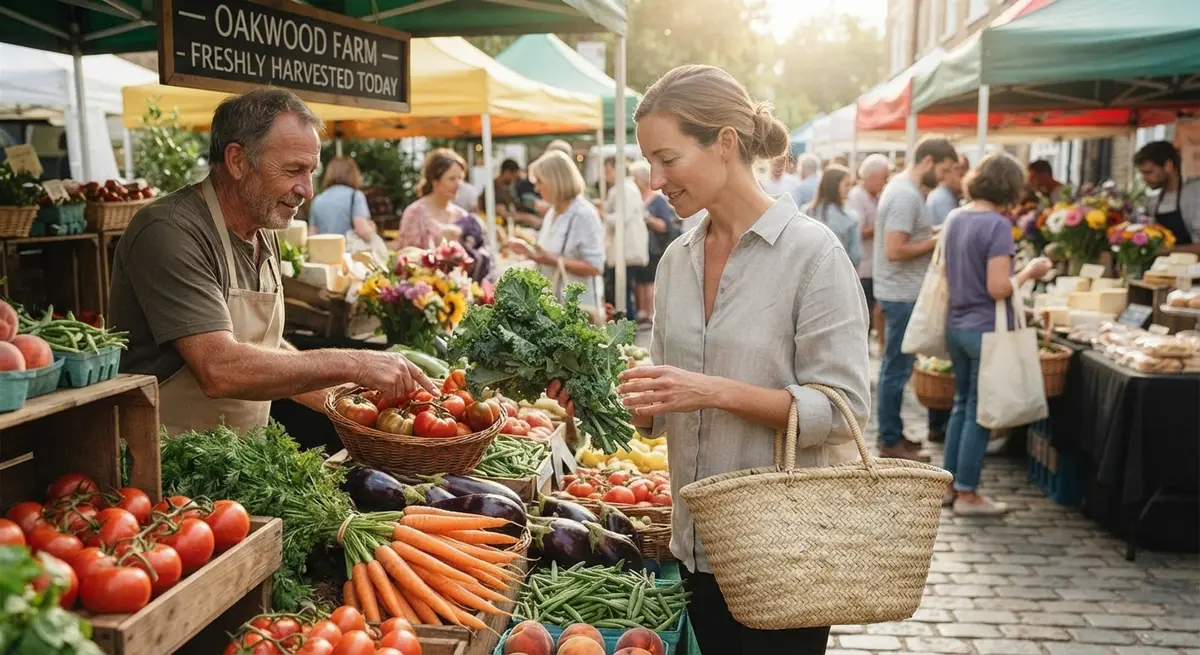
I once bought a peach at a farmers market that I still think about with unreasonable frequency. It was unassuming — small, slightly dented, matte rather than glossy — and the woman who sold it said four words I'd never heard at a supermarket: "It was on the tree this morning." That peach had a perfume, a juice that ran to my elbow, and a flavor that made the idea of a "peach-flavored" product feel like a category error. It practically rewired my relationship with fruit.
Before that peach, I thought markets were where you pay more for the pleasure of sun and straw hats. Since then I've shopped them like a professional — at 8 a.m. when the first flats come off the truck, and at 1 p.m. when the same growers are packing up and pricing to move. The truth is that a farmers market rewards people who know what to look at, what to ask, and when to show up. Here's everything I wish someone had told me.
Two Different Market Visits
Most people treat the market as one event. In fact, it rewards two opposite trips, and I plan them separately:
- The early bird (opening to 9 a.m.). This is the freshness pass. Growers unload overnight harvests, and the first-flat stock is the best — fullest, most hydrated, least handled. Go early for what you'll eat within three days and for rare finds that sell out, like single-picking strawberries or the first asparagus.
- The closer (last 30 to 60 minutes). This is the budget pass. As packing-up hour approaches, growers would rather sell than haul: second bunches half priced, mixed-bag deals, bargaining the morning crowd never sees. You trade perfection for volume.
The key is knowing which pass you're doing before you arrive. An end-of-day bag is great for tonight's dinner and a gamble for next week's canning.
Pro tip: If your market has a thin season, ask vendors which nearby market is the "big day." Small towns often run a weekday market that's twice the size of Sunday's, and that's where the real variety hides.
Read the Stalls: Who Actually Grows Your Food
Not every stall is a farm. Between the roadside fruit truck, the reseller, and the certified organic grower there's a spectrum, and the game is figuring out which end you're at. A reseller's crates are uniform, packed evenly, identical across the stall. A farmer's produce varies in size, shade, and shape — because it grew that way. Ask three questions to test any stall:
- "What was picked today?" A confident "this morning" is the stall's best claim.
- "What got hit by the weather?" Growers love telling you about the cold snap that split the tomatoes. This question separates a grower from a clerk instantly.
- "What do you eat yourself?" A farmer's favorite is usually the most honest product, and naming it shows you where their pride lives.
The Seasonality Cheat Sheet
Realism about the calendar is a superpower. Don't ask for what shouldn't exist in your month:
- Spring: asparagus, ramps, early radishes, green garlic, peas, strawberries near the end.
- Summer: tomatoes, corn, stone fruit, berries, zucchini, eggplant, peppers.
- Fall: squash, pumpkins, apples, pears, grapes, Brussels sprouts after frost.
- Winter: hard squash, parsnips, turnips, storage cabbage, hardy greens like kale.
Most visitors follow the same pattern: they ask for tomatoes in July (correct) and again in late September (too late). If a vendor sells tomatoes in November, they grew them in a hoop house or imported them — both honest facts, and now you know what you're buying.
The Freshness Test That Doesn't Lie
Forget the squeeze-the-avocado folklore. Better tests exist and work across almost all produce:
- Smell is the honest sense. Ripe fruit perfumes the air from a foot away. If a peach or melon doesn't, it was picked green — no counter time will fix it.
- Weight tells water content. A heavy watermelon or tomato means recent harvest. Lighter is older.
- Listen to the stem. Firm, snapping stems on greens mean recent; limp stems mean they've traveled.
- Don't judge by shine. A glossy supermarket apple is polished; a matte, dusted market apple just came off the tree. Shine is a sales tool, not ripeness.
Pro tip: Asking for one taste is more normal than you think. Most growers hand over a sample gladly; the ones who refuse probably don't want you tasting what they're selling.
Shop the Whole Week in One Walk
Arrive with a rough menu plan and walk the market in three passes:
- Observation: the whole loop without buying, noting who's busy and what's actually in season.
- The shop: your week's backbone — one protein, the bulk vegetables you'll roast, the staples.
- The treat: spend spare budget on the one thing that made your eyes light up in pass one.
For most households, five or six vegetables, one protein, and one treat support a week of cooking — and usually land close to, or under, the supermarket total, once you stop buying things that will rot before you eat them.
Store It the Same Day
The greatest enemy of market produce isn't the grower; it's your fridge and your Tuesday schedule. Wash and process anything delicate the day you get home: greens into a damp-towel bag, berries eaten first, herbs dried or stem-down in water. Tomatoes, basil, and ripe melons should never meet the fridge — cold steals their flavor chemistry. And freeze at peak, not at desperation: anything you can't eat in four days becomes soup, stock, or a freezer bag at its best moment.
FAQ
What is the best time to go to a farmers market?
For top quality, arrive at opening and buy what was picked that morning. For bargains, go in the last hour when growers price to move. These are opposite strategies — decide which you're doing before you show up.
How can I tell if produce is really local and fresh?
Ask what was picked today, read the stall for signs of a grower (varied sizes, soil on roots) versus a reseller (uniform crates), and rely on tests that don't lie: smell, weight, stem snap, and cut-stem appearance.
Is a farmers market more expensive than the supermarket?
For equivalent quality, no — but only if you shop with a plan and don't carry home things that will go bad. The market's premium disappears next to the organic aisle, and you lose less food because you eat what you choose.
What should I do with more produce than I can eat?
Process the same day: freeze at peak flavor, make stock or sauces, pickle and ferment the extras, or share. Market produce should never rot in your crisper while you rebuy the same vegetables at the store.
Key Takeaways
- Decide between the freshness pass (opening) and the budget pass (closing) before you arrive.
- Read stalls for signs of real growers: varied produce, soil-crusted roots, and pride in weather talk.
- Ask "what was picked today," "what got hit by the weather," and "what do you eat yourself."
- Shop the calendar — only buy what should exist in your month, and treat shine as a sales tool.
- Use the freshness tests: smell, weight, stem snap, and cut-stem appearance beat any squeeze.
- Process, store, and freeze produce the same day you buy it, and keep cold-friendly foods out of the fridge.
A Final Word
That little dented peach changed my shopping habits and a small part of my week. Farmers markets aren't a premium detour from real grocery shopping; they're a direct tap into the tastiest, most alive version of your food, provided you know how to shop them — with a strategy, honest questions, and a calendar in your head. Show up at the right hour, buy what was truly picked, test by smell and weight, and get it into the kitchen the same afternoon. The market rewards patience and curiosity more than money, which for anyone who cooks is the best deal of the week.
Published on 2026-08-13 by the QuiteRecipes team (Jamy & Kaïna).
Related Articles
Food Souvenirs: The Best Culinary Keepsakes to Bring Back from Your Trips
The best food souvenirs travel well, clear customs easily, and remind you of the trip every time you cook. Here is what to buy, skip, and pack.
How to Cook with Ingredients You Picked Yourself (Foraging 101)
Foraging turns a walk into a pantry. Start with ramps, blackberries, and wild garlic, follow positive-ID rules, and cook what you pick same-day.
How to Eat Like a Local Wherever You Travel
Stop eating where the travel apps point. Here is how to find the tables locals actually queue for, order with confidence, and eat like a local on any trip.
How to Find Hidden Gem Food Spots in Any City You Visit
Hidden-gem food spots are findable everywhere. Here is how to triangulate local sources, read menus, and walk neighborhoods to find the real tables.
About the Authors
This recipe and guide was developed, tested, and approved in our home kitchen and daily life. Jamy is a retired Food Service District Manager and Early Childhood Program Manager who spent his career overseeing multi-site restaurant operations, large-scale culinary production, and daycare menu management. Kaïna brings the ultimate real-world test: making sure it brings ease and joy to our kids on a busy weeknight.
Read more about our professional background and philosophy →