The Power of Scent: How Essential Oils Can Change Your Home's Mood
By the QuiteRecipes team (Jamy & Kaïna)
A few drops of lavender or citrus can reshape the mood of a room. Learn safe ratios, the best calm and focus blends, and the common mistakes to skip.
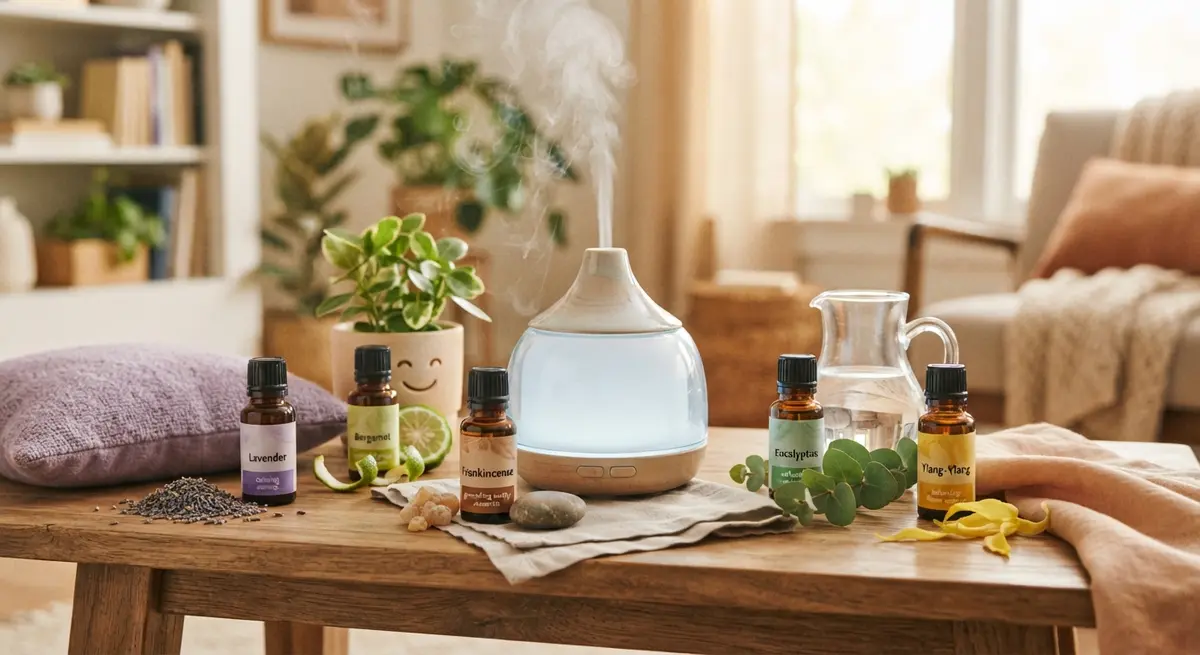
The first time I ever diffused essential oils, I made every mistake a person can make in one evening. I bought a cheap blend at a farmer's market, dumped a generous amount into a diffuser I didn't understand, and let it run in a tiny bathroom with the door shut. Twenty minutes later my head was pounding and the room smelled like a candle shop that had exploded. I told myself aromatherapy was nonsense and shoved the bottle into the back of a drawer, where it sat for a year.
It took a patient friend and a much more careful second attempt to show me what I'd gotten so wrong. She poured exactly three drops of lavender into a ceramic diffuser in the living room, opened a window, and let it run for twenty minutes before I even noticed. The shift wasn't a perfume blast; it was a hush. The room went from "cluttered and loud" to "settled and soft," and I watched two family members' shoulders drop without anyone saying a word. Scent, I learned, was real — it just obeys rules I hadn't bothered to learn.
Let me be very direct about the boundaries up front, because the wellness aisle is full of overpromises. Essential oils are aromatics, and a growing body of research shows scent can influence mood, memory, and attention. They are not a treatment for anxiety, depression, sleep disorders, or anything medical — and if you have asthma, allergies, or respiratory conditions, or you're pregnant, check with your healthcare professional before diffusing anything. The claims I'll make here are modest ones you can reproduce at home: scent that helps you feel more awake, more settled, or more present. Full stop.
How Scent Actually Reaches Your Mood
The mechanics are genuinely fascinating, and knowing them helps you use the stuff well. When you inhale a volatile compound, thousands of odorant molecules travel up your nose to the olfactory epithelium, where receptor cells fire signals straight to the olfactory bulb. The olfactory bulb sits right next to the limbic system — the brain's emotional and memory centers — and this is why smell is the sense most tightly wired to memory and feeling. A whiff of cedar can drag you to your grandfather's workshop; a particular soap can time-travel you to a hotel in Lisbon. No other sense does this so immediately.
Here's what this means practically: smell isn't a "nice extra," it's a fast, pre-verbal mood signal. This is exactly why research on aromatherapy has focused on things like lavender for relaxation and peppermint or citrus for alertness. A 2021 meta-analysis in the journal Complementary Therapies in Medicine, pooling randomized controlled trials, found that lavender aromatherapy was associated with reduced anxiety in several clinical populations — but note the careful language. It "was associated with" and "in several populations"; it's not a universal guarantee, and in a medical context it's an adjunct, not a treatment. Use the research as direction, not as a diagnosis.
The two real mechanisms at work: First, expectation and association — if you tell yourself this lavender scent means "calm," and you've often smelled it while relaxing, your brain leans into calm. Second, genuine neurological signaling from certain compounds. Both work. Neither is a cure. That's the honest and useful truth.
The Golden Rules: Ratios, Timing, and Clean Air
If you take one thing from this article, make it these four rules, because they prevent the exploding-candle-shop disaster and a dozen subtler mistakes.
- Rule one: a little is a lot. For a 100–200 ml diffuser, three to five drops is plenty for an average room. For a candle warmer or a ceramic locket, one to two drops. Start low; you can always add a drop, but you cannot un-add it.
- Rule two: diffuse in bursts, not continuously. Running a diffuser all day overwhelms the senses — and, importantly, olfactory adaptation means you'll stop noticing the scent within about fifteen to twenty minutes anyway. Run it for twenty to thirty minutes at a time, and your nose stays sensitive enough to enjoy each burst.
- Rule three: respect the air you share. If you live with pets, children, anyone pregnant, or anyone with respiratory sensitivity, keep concentrations low, diffuse in ventilated rooms, and let everyone have an easy way out. Many essential oils are strong, and some are problematic for pets (cats are especially sensitive). When in doubt, use less and ventilate more.
- Rule four: choose reputable oils, not expensive marketing. Look for oils that state their botanical name (e.g., Lavandula angustifolia for true lavender) and their purity. You don't need a $40 bottle; you need a trustworthy one. A decent 10 ml bottle of a single oil typically runs $10 to $20. Avoid anything labeled "fragrance oil" — that's synthetic scent, not the plant distillation you're paying for.
Pro tip: Keep a small notebook or notes app with the three-sentence recipe for each blend you love, plus the exact drop count. Nothing loses the magic of a good blend faster than forgetting the ratio that made it work.
Your Starter Pantry: Six Scents That Earn Their Place
For under a hundred dollars, you can build a versatile home kit. Here are the six I'd start with and what each does best, alongside a pairing that punches above its weight:
- Lavender (Lavandula angustifolia): the classic for relaxation and winding down. Diffuse two to three drops with one drop of bergamot thirty minutes before bed, on a twenty-minute timer.
- Bergamot (Citrus bergamia): bright, slightly floral, mood-lifting. It's the workhorse of "chase the fog away" blends. Digital note: bergamot oil is phototoxic, so avoid putting it on skin and then going into strong sunlight — keep it in the diffuser, not on your wrists.
- Peppermint (Mentha piperita): crisp and alertness-promoting, great in a home office or before a task. One drop in a personal diffuser next to your laptop. If you get a headache from scent, skip it — mint can be irritating for sensitive noses.
- Sweet Orange (Citrus sinensis): warm, sunny, and instantly welcoming for a living room or entryway. Try sweet orange with a single drop of clove for a subtle, cozy autumn note.
- Eucalyptus (Eucalyptus globulus): medicinal and clarifying, often used in steamy bathrooms. Keep it out of reach of pets and use in a fan-ventilated space.
- Cedarwood (Cedrus atlantica): earthy, grounding, and woody — the opposite of perfumey. Blend with lavender for a deep, quiet evening note.
Start with lavender and sweet orange. Those two alone, diffused at different times, will teach you the diffuser mechanics and the mood shift better than a ten-bottle collection ever will.
Blends for Moods: Three Recipes You'll Actually Repeat
Here are three blends I cycle through, written for a diffuser and timed for the moment they feel right.
The Wind-Down (evening): three drops lavender, one drop bergamot, one drop cedarwood. Run twenty minutes, thirty minutes before bed, with the lights dimmed.
The Awake (morning): one drop peppermint, two drops sweet orange. Run one burst of twenty minutes while you make coffee. The peppermint says "wake," the orange says "bright," and together they do what a second espresso shouldn't have to.
The Get-It-Together (focus session): two drops bergamot, one drop cedarwood, one drop eucalyptus. This is my deep-work blend for a fifty-minute writing block; scent becomes the "hands off my phone" trigger.
Pro tip: Set the diffuser to a timer rather than leaving it on endlessly. Fifteen to twenty minutes gives you the mood shift and then steps aside before your nose tunes it out or your head gets heavy — the two failure modes that make beginners quit.
The Mistakes That Make Scent Go Wrong
Almost every "essential oils don't work" story I've heard is actually a "I used them badly" story. Here are the five common avoidable errors:
Mistake one: using far too much. The pounding headache in my opening anecdote was pure overdose. Start with three drops. You can always add one more. Respect the ratio and your nose will thank you.
Mistake two: diffusing continuously all day. Constant scent stops working (adaptation) and can irritate sensitive lungs. Bursts of twenty to thirty minutes, a few times a day, give you the benefit without the wall of perfume.
Mistake three: buying "fragrance oil" thinking it's the plant. Synthetic fragrance isn't aromatherapy, and it often carries perfumey base notes and potential irritants. Read the label for the botanical name and "100% pure essential oil."
Mistake four: ignoring household air quality. A diffuser in a stuffy, unventilated room just scents stale air. Crack a window, run a fan, and let fresh air move. The scent works better and your lungs stay happy.
Mistake five: applying oils to skin without knowledge. Essential oils are concentrated and can cause irritation or sensitivity. The safest entry point is the diffuser. If you're curious about topical use — for a bath, a massage, or a roll-on — learn the proper carrier oil dilutions first (typically a few drops per tablespoon of carrier), patch test, and never apply undiluted oil to skin. When in doubt, diffuse instead.
Mistake six: ignoring pets and sensitive housemates. Cats in particular lack the liver enzymes to metabolize many essential oil compounds, and birds are extremely sensitive. Research what's safe for your household, diffuse in ventilated rooms, and give everyone an escape. "Aromatherapy for everyone" is a myth if someone in the house is harmed by it.
FAQ
Are essential oils safe for everyday home use?
For most people, yes, when used properly: small amounts, short diffusion bursts, ventilated rooms, and reputable oils. But safety depends on your household — pets, kids, pregnant people, and anyone with respiratory conditions change the calculus. When in doubt, use less and ask a professional.
Can essential oils really reduce stress?
Scent can influence mood through both association and neurological signaling, and research like the lavender meta-analyses shows modest associations with reduced anxiety in some populations. But this is a supportive, sensory practice, not medical treatment. For persistent stress or anxiety, see a doctor or therapist.
What's the difference between essential oil, fragrance oil, and "aromatherapy blend"?
An essential oil is distilled from the actual plant and labeled with its botanical name. A fragrance oil is a synthetic scent used in candles and diffusers. An "aromatherapy blend" is usually several essential oils mixed for a purpose. For authentic scent experience, choose the real distilled oils.
How much oil should I use in a diffuser?
Three to five drops for a standard 100–200 ml room diffuser; one to two drops for a personal diffuser or warmer. Start low and add only if needed. More drops rarely mean more effect; they usually mean a headache.
Can I diffuse oils safely around pets?
- Scent reaches your emotional brain faster than almost anything, via the direct nose-to-limbic-system connection.
- The real mechanisms are association and genuine neurological signaling; both are useful, neither is a medical treatment.
- Golden rules: three to five drops for a room diffuser, diffuse in twenty-to-thirty-minute bursts, ventilate, and buy oils labeled with botanical names.
- Start your pantry with lavender and sweet orange; add bergamot, peppermint, eucalyptus, and cedarwood as you grow.
- Repeatable blends: Wind-Down (lavender, bergamot, cedarwood), Awake (peppermint, sweet orange), and Get-It-Together (bergamot, cedarwood, eucalyptus).
- Avoid the classic errors: overdosing, continuous diffusion, fragrance oils, ignoring air quality, unsafe topical use, and forgetting pets.
A Final Word
That first diffuser night ended with my head pounding and oils retired to a drawer. A year later, three careful drops of lavender turned the same living room into the quietest corner of my week. The difference wasn't a better bottle; it was respect — for ratios, for timing, for the air, and for the modest, lovely thing scent can actually do. Start there, with a splash of citrus in the morning and a whisper of lavender at night, and let the room teach you the rest.
Published on 2026-08-13 by the QuiteRecipes team (Jamy & Kaïna).
Related Articles

5 Simple Ways to Be a More Gracious and Relaxed Dinner Host
Gracious hosting isn't about fancy food. It's five repeatable habits that calm the room — and you.

Bringing Vacation Home: How to Recreate Food Memories in Your Own Space
You can't bring the trip back, but you can bring its flavors. Here is how to turn travel food memories into weeknight meals in your own kitchen.

Composting at Home: A Beginner's Guide to Turning Scraps into Gold
Composting is the easiest way to turn food waste into garden gold. Start with a bin, learn the green-to-brown ratio, and watch it work.
Creating a Cozy Reading Nook Right Next to Your Dining Area
Create a cozy reading nook beside your dining area without a redesign. Find the right corner, lighting, and chair for under $150.
About the Authors
This recipe and guide was developed, tested, and approved in our home kitchen and daily life. Jamy is a retired Food Service District Manager and Early Childhood Program Manager who spent his career overseeing multi-site restaurant operations, large-scale culinary production, and daycare menu management. Kaïna brings the ultimate real-world test: making sure it brings ease and joy to our kids on a busy weeknight.
Read more about our professional background and philosophy →