Simple Homemade Gifts from Your Kitchen That Anyone Will Love
By the QuiteRecipes team (Jamy & Kaïna)
Skip the gift-card stall. With pantry staples and a couple of afternoons, you can make small-batch jams, infused oils, and cookie kits people genuinely treasure. Here's how to gift from your kitchen without the stress.
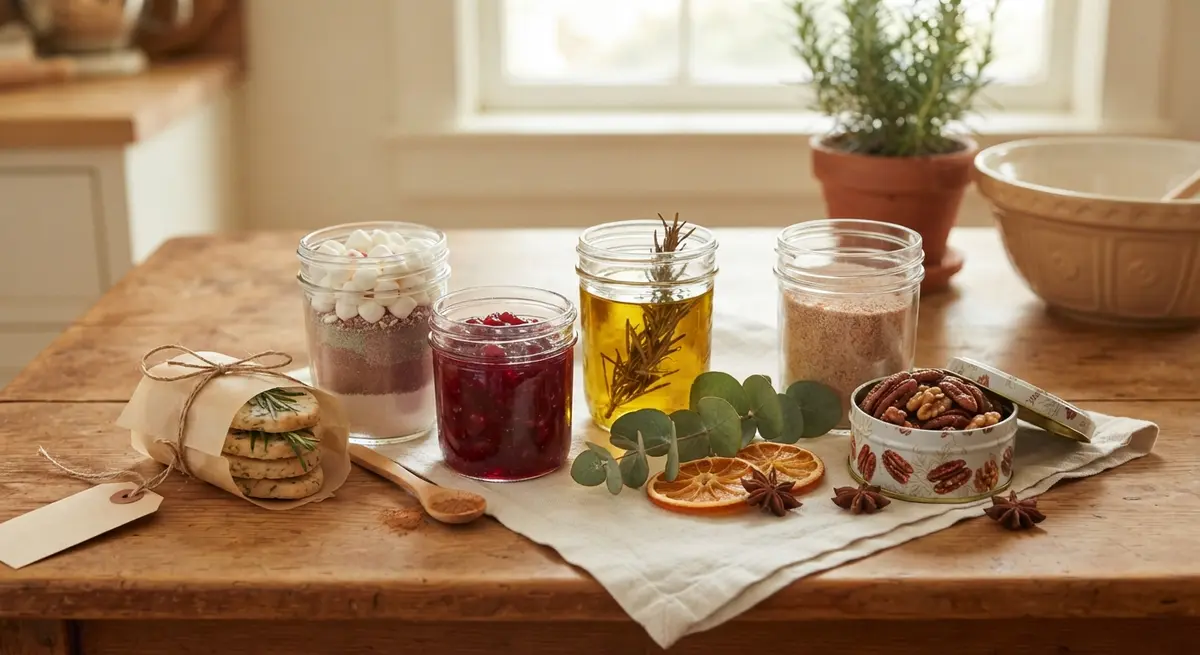
There was a Christmas a few years ago when my budget and my pride collided. I had twelve people to gift and roughly the price of a nice candle to my name. That December, every person on my list received something from my kitchen — vanilla bean sugar, a jar of cranberry jam, and foolproof cookie mixes in repurposed jars — for under $40 total.
The surprise wasn't the money. It was the response. The jam jar came back empty with a text asking for the recipe. No store-bought gift I've given landed like that, because a homemade gift doesn't say "here is a product." It says "I spent hours thinking about you."
This guide covers four genuinely simple homemade gifts — infused oils, small-batch jams, dry baking mixes, and travel-worthy cookies — plus the shelf-life rules and budget math.
Why Kitchen Gifts Win (and the Numbers Back It Up)
The math was my original motivation, and it's still my most convincing argument.
- The average US consumer spends $25–$35 on a single store-bought gift. A 16-ounce mason jar of homemade cookie mix costs $1.50–$2.50.
- A quart of store-bought infused olive oil runs $12–$20. One bottle of oil and a handful of rosemary makes four 8-ounce gifts for about $3.50 total.
- Half-pint jars of artisan jam sell for $9–$14. A 12-ounce bag of frozen berries makes three half-pints for $4–$6.
That's an 80–90 percent price gap. But the value gap runs the other way: a handwritten label and your signature are worth more than any fancy box.
The rule I give every friend: a homemade gift should cost about the same as a greeting card and be remembered longer than a gift card.
The Golden Rules Before You Touch a Pan
Gifting food has only three hard rules, and none of them are hard.
1. Know your shelf life and say it out loud. Every jar gets a label with what it is, the date made, and a "best by" date I'm confident in.
2. Trust your thermometer, not your memory. For anything shelf-stable, precise temperatures matter. I always use a digital thermometer for jam set point and oil infusion heat.
3. Package for survival, not just beauty. Lids get tightened, then tested by turning the jar upside down for five seconds. Liquid gifts travel wrapped in a produce bag. Ugly insurance, but it works.
Gift One: Infused Oils and Vinegars (the Elegant 90-Minute Gift)
Infused oil costs pennies and looks boutique. There are two ways to make it: the safe way and the dangerous shortcut.
The dangerous shortcut? Garlic cloves and herbs left raw in room-temperature oil — a textbook botulism setup, and the reason people fear homemade oil. The safe way is a gentle heat, and it's just as easy.
The rosemary oil that never lets me down:
- Toast 2 sprigs of fresh rosemary in a dry pan for 30 seconds to draw out the aroma.
- Warm 1 cup of good olive oil over low heat to about 185°F — hot enough to infuse, nowhere near smoking.
- Add the rosemary and hold at 185–200°F for 10 minutes.
- Strain, pour into a clean, dry 8-ounce bottle, and refrigerate.
Made this way, the oil keeps about 4 weeks refrigerated. For an even lazier version, skip the heat: 2 tablespoons of dried rosemary plus oil in a sealed jar, in the fridge, use within 1 week.
I also make citrus vinegar with leftover lemon and orange zest (no white pith) soaked 3 days in white wine vinegar in the fridge, then strained. It keeps for months and makes a dressing that feels illegal to be this good.
The label that saves a gift: "Rosemary Olive Oil — keep refrigerated — use by [date]. Drizzle on bread, salads, or roasted veg."
Gift Two: Small-Batch Jam (the One That Gets Texted Back)
Jam is my emotional favorite because people actually use it — on toast, in yogurt, swirled into oatmeal — and then they text you. My most-requested batches: cranberry-orange, strawberry-balsamic, and fig with cracked black pepper.
The forgiving small-batch technique (no water bath needed if you store properly):
- 2 cups (about 14 ounces) of fruit, fresh or frozen.
- 1 cup sugar, or 3/4 cup if the fruit is very sweet.
- 2 tablespoons lemon juice.
- 1.75 ounces of low-sugar pectin for a true set.
Cook over medium heat until the fruit breaks down, then boil until the setting point. Test the cheap way: chill a plate, drop a spoonful on it, wait 30 seconds, and drag a finger through — if it wrinkles and holds a channel, it's set. My thermometer target is 220°F, and because every stove lies a little, I test the plate too.
Let it rest off the heat for 5 minutes before ladling so the fruit doesn't float. Sealed jars are pantry-safe; the lids "pop" as they cool.
- Short-term: a filled jar keeps 2 weeks refrigerated, no fuss.
- Long-term: hot-packed and sealed, 3–4 months in the pantry or up to a year refrigerated or frozen.
Gift Three: Baking Mixes in a Jar (the $2.50 Showstopper)
A cookie mix in a jar looks constructed by elves but is assembled by logic. My signature is a brown sugar–oatmeal mix — sugars, oats, flour, cinnamon, and chocolate chips layered so the stripes read like a work of art.
The assembly-line math: one batch (24 cookies) fills a 32-ounce jar at about $1.80–$2.50, and bulk-bought oats and flour push it under $1.50.
The gift tag doubles as the recipe — the detail that makes the gift complete:
"To make: cream 1/2 cup softened butter with 1 egg. Stir in the jar contents. Scoop 2-tablespoon balls onto a lined sheet. Bake at 350°F for 11–13 minutes, until edges are golden. Makes 24."
Mix mistakes I've made so you don't have to:
- Skipping the whisk. The dry goods need a good whisk before layering, or the baking soda clumps in a corner and the cookies bake lopsided.
- Layering sugar against moisture. Put chips or oats between the sugar layers so the sugar stays dry; seal the jar tight.
- Forgetting the instruction card. The recipe is half the gift; without it, the jar is a mystery that lives in the pantry till spring.
Baking mixes keep 3–4 months stored airtight and cool, and they travel beautifully because there's nothing to spill.
Gift Four: Cookies That Travel (the "Emergency" Gift)
Some gifts are made the same day and enjoyed within a week, and nothing lands like a tin of real cookies. My travel workhorses are brown butter shortbread and salted chocolate chip cookies — sturdy enough to survive a car ride and good enough to start a small feud.
The brown butter step (extra 15 minutes, worth it): melt butter in a pan, let it foam, then turn golden and smell nutty. Off the heat, cool it until barely warm before adding sugar — hot butter scrambles the eggs. That nutty note reads as "professional bakery."
Storage talk:
- Shortbread, airtight at room temperature: 1–2 weeks; it dreads humidity.
- Chocolate chip at room temp: 3–5 days and best within 48 hours — why I bake the day before delivery.
- Freezer backup: baked cookies freeze 2–3 months double-wrapped and thaw in 15 minutes.
The packing rule: one layer of cookies, wax paper between layers, crumbs and all. Crammed cookies arrive as crumbs and a sorrowful tin. I've shipped sorrowful tins.
The Bonus Shelf: Three "Cheat" Gifts That Take 20 Minutes
Not every gift needs to be a production. These three take twenty minutes and delight people beyond their effort:
- Vanilla bean sugar. Bury a split vanilla bean in 2 cups of sugar; it turns fragrant within a week. Tag: "for coffee, oatmeal, or a cocktail rim."
- Hot chocolate mix. Sift 1/2 cup cocoa with 3/4 cup sugar and 1/4 teaspoon salt into an 8-ounce jar. Tag: "add boiling milk."
- Chili-cocoa rub. A tiny jar of smoked paprika, brown sugar, cocoa, salt, and cumin turns into a steak rub with a tag naming the ratios.
I reach for these for the edge of my list — the teacher, the mail carrier, the coworker — because they cost under a dollar each and say "I thought of you" without claiming an afternoon.
The Common Mistakes (a Confession List)
I have made every mistake on this list:
- Not labeling. A mystery jar is wasted effort. Label, date, and note usage.
- Using soggy or bruised produce. Jam from overripe fruit sets poorly and keeps badly.
- Ignoring the botulism rules on oils. Never raw garlic in room-temperature oil. Heat it, refrigerate it, date it. Non-negotiable.
- Loose lids on hot jars. Wait for jars to cool before tightening or you risk cracked glass.
- Gifting "someday" food. Only gift what you'd actually eat within the stated window.
- Forgetting dietary tags. Mark nuts, gluten, and dairy clearly — roughly 1 in 10 people has a food intolerance, and a written note protects your thoughtful gift.
Budgeting the Whole Operation
Here's honest math for a list of ten people:
- Infused oils (4 small gifts): $3.50–$5
- Jams (6 half-pints): $9–$12
- Cookie mixes (4 jars): $7–$10
- Hot cocoa mix (10 small jars): $6–$8
- Jars, lids, ribbon, tags: $12–$20
Total: roughly $40–$55 for ten thoughtful gifts — about $4–$5.50 per person. Even buying all jars new, you stay under a third of the cost. Nothing in that list is a compromise.
The Shelf-Life Cheat Sheet
Label everything, and use these windows:
- Infused oil (refrigerated): 4 weeks.
- Citrus vinegar: 2–3 months.
- Small-batch jam: 2 weeks refrigerated; 3–4 months sealed.
- Dry baking mix: 3–4 months.
- Cookies: 3–5 days to 2 weeks, depending on type.
- Frozen baked cookies: 2–3 months.
- Vanilla sugar and cocoa mix: 6 months.
- Spice rubs: 3–4 months (spices fade).
Print that, tape it inside your pantry door, and you'll never gift a sketchy jar again.
FAQ
How long do homemade food gifts actually last?
Most hold for 2–4 months with proper labeling and storage, but the window depends on the gift: infused oils last about 4 weeks refrigerated, sealed jams 3–4 months in the pantry, dry mixes 3–4 months, and cookies from a few days to a couple of weeks. Always label with a "best by" date.
Is it safe to gift homemade infused oils?
Yes, when made the safe way: never raw garlic or herbs sitting in room-temperature oil. Heat gently to about 185–200°F, strain, refrigerate, and date. Under those rules, infused oil is a lovely, safe gift within 2–4 weeks.
Can I gift jam without a full canning setup?
Absolutely. For refrigerated gifting, hot-fill clean jars and refrigerate immediately — they'll keep 2 weeks. For shelf-stable gifts you need a proper hot-water-bath seal with lids that "pop"; if you don't want that setup, just label jars "Keep refrigerated."
What's the cheapest homemade gift that still feels special?
Cookie mixes in a jar and vanilla bean sugar top the list. Both cost roughly $1.50–$2.50 per gift, use pantry staples, and look intentional on a counter. The recipe tag is what elevates them from "pantry" to "present."
How do I handle dietary restrictions on labels?
Note the big three clearly — nuts, gluten, and dairy — with a line like "Contains wheat and milk; made in a kitchen that handles nuts." It costs ten seconds and protects both the recipient's health and your intention.
Key Takeaways
- Homemade gifts cost 80–90% less than store-bought equivalents and are remembered far longer.
- Follow the food-safety rules: label with dates, heat oils properly, refrigerate perishables, and never skip the "best by" note.
- Four simple hits cover most lists: infused oil, small-batch jam, cookie mixes, and travel-worthy cookies.
- The recipe tag is half the gift — it turns a jar into an experience.
- A full list of ten runs about $40–$55, or $4–$5.50 per person.
A Final Word
That first December of kitchen gifting, I was sure my jars would come across as cheap and awkward. Instead, I started a tradition: two friends now make my cranberry jam themselves, one has asked for "that vanilla sugar" for three birthdays in a row, and my own pantry holds hand-labeled gifts from people I love. A jar from your kitchen doesn't compete with store displays — it beats them, because it carries your hour in every spoonful. Heat the water, open the pantry, and give the people you love a reason to text you the words every cook wants to hear: "Send the recipe."
Published on 2026-08-13 by the QuiteRecipes team (Jamy & Kaïna).
Related Articles

5 Simple Ways to Be a More Gracious and Relaxed Dinner Host
Gracious hosting isn't about fancy food. It's five repeatable habits that calm the room — and you.
Bringing Vacation Home: How to Recreate Food Memories in Your Own Space
You can't bring the trip back, but you can bring its flavors. Here is how to turn travel food memories into weeknight meals in your own kitchen.
Composting at Home: A Beginner's Guide to Turning Scraps into Gold
Composting is the easiest way to turn food waste into garden gold. Start with a bin, learn the green-to-brown ratio, and watch it work.

Creating a Cozy Reading Nook Right Next to Your Dining Area
Create a cozy reading nook beside your dining area without a redesign. Find the right corner, lighting, and chair for under $150.
About the Authors
This recipe and guide was developed, tested, and approved in our home kitchen and daily life. Jamy is a retired Food Service District Manager and Early Childhood Program Manager who spent his career overseeing multi-site restaurant operations, large-scale culinary production, and daycare menu management. Kaïna brings the ultimate real-world test: making sure it brings ease and joy to our kids on a busy weeknight.
Read more about our professional background and philosophy →