The Evening Kitchen Reset Habit That Will Change Your Mornings
By the QuiteRecipes team (Jamy & Kaïna)
Reset your kitchen in 20 quiet minutes tonight and wake up to a calmer, faster, more pleasant morning tomorrow. One habit, real change.

The last time I had a truly terrible morning, it started the night before without me noticing. I had cooked a big pot of lentil soup, eaten a bowl, and announced I'd "deal with the kitchen in the morning." Morning arrived in the form of an alarm I didn't respect, a sink full of clouded dishes, a crusted pot that needed two hours of soaking, and a coffee mug I had to wash before I could get my first dose of caffeine. I stood there at 7:15 a.m., scrubbing a bowl with cold water, half-asleep, and I genuinely could not remember the last time I'd started a day without immediately fighting my own kitchen.
That week, a friend whose mornings had always seemed weirdly serene told me her secret: she never goes to bed with a dirty kitchen. Not "I'll get to it tomorrow" clean. Reset clean. Sink empty, counters wiped, coffee supplies at the front, breakfast plan chosen. She said it takes her about twenty minutes of quiet, aimless tidying while her dinner digests, and it costs her almost nothing because she's watching the clock anyway. I was skeptical. I was also tired of cold-water scrubbing. So I tried it for one week. I have now done it for several hundred consecutive nights.
Before we start, one honest note: this article is about household habits and personal wellbeing, not medicine. If your mornings are chaotic because of a health condition, significant fatigue, or a sleep issue, that's a conversation for your doctor. This habit is a useful layer on top of good care, never a substitute for it.
Why Twenty Minutes Tonight Buys You Two Hours of Peace
There's a reason restaurants end every shift with a full reset. It's not about perfection or showing off; it's about the fact that a cook who starts their day with a clean, organized station works faster, makes fewer mistakes, and gets stressed out less. Your home kitchen is the same kitchen. When you walk in at 7:00 a.m. and the counter is clear, the sponge is in its dish, and tomorrow's ingredients are already measured, the first ten minutes of your day are productive instead of defensive.
Think about what a dirty kitchen demands from your morning brain:
- A sink full of dishes means triage: what's usable, what needs scrubbing, what did I even dirty?
- A sticky counter means you're wiping before you can place a cutting board, delaying your first task.
- Yesterday's clutter means visual noise: your eyes scan piles while your hands look for the kettle.
- No prepped breakfast means a decision making session at 7:15 a.m., when your prefrontal cortex is still asleep.
Each of those costs somewhere between two and ten minutes, plus a slice of "I'm already behind" feeling that can color the rest of the day. The reset erases all four categories at once. This is the rare habit with a near-immediate payoff: you do it once tonight, and tomorrow is observably better. You don't need faith in a long-term payoff you can't see yet.
The Twenty-Minute Reset, Step by Step
Here's the exact sequence that worked for me, in order. The order matters more than the speed, because it batches the messy work together and ends with the satisfying, visible finish.
- Minutes 0–5: Sink and dishes. Empty the dishwasher if it has clean dishes (do this first, while your head is fresh). Stack dirty dishes neatly, scrape scraps, and fill the sink with hot, soapy water. For the truly crusted pots, you don't scrub yet — you let them soak while you finish the rest.
- Minutes 5–10: Wipe and clear. Put away anything that belongs elsewhere: the mail, the kid's homework, the grocery bag that's been by the door for two days. Wipe the counters with warm soapy water, then the stovetop, remembering the back burner area where splatters hide. Ten minutes of wiping and putting-away fixes ninety percent of visual chaos.
- Minutes 10–15: Scrub the pots. By now the soak has done its job, so the stuck soup slides off in under a minute instead of a fight. Dry the sink, rinse the sponge, and put it in its holder. Feel free to enjoy this specific five minutes; it's the most satisfying part.
- Minutes 15–18: Set up tomorrow's station. This is the magic step. Lay out the coffee (grounds in the filter, water measured, or the pods staged by the machine), place the mug and a granola bowl, and put any breakfast ingredients at the front of the fridge. If you're making something like overnight oats, this is the moment to assemble it.
- Minutes 18–20: Lights-off check. Stand at the doorway, scan the room, spot the one thing out of place, and fix it. Then turn off the light. Done.
Pro tip: Keep a small timer or just use your phone's stopwatch with the screen face-down. The ritual isn't about hitting twenty minutes exactly; it's about letting your body know the reset is a finite, coasting task rather than an open-ended chore that might swallow the evening.
The One Rule That Makes It Stick: Make Tomorrow's Start Obvious
The single insight that changed this from a chore into a habit was realizing that the reset's real product isn't a clean kitchen. It's a decided tomorrow morning. People don't fail mornings because they're lazy; they fail because they expect themselves to make good, quick decisions at 6:50 a.m. before caffeine.
So the evening reset becomes a decision machine:
- Coffee machine loaded means zero decisions about breakfast fluids.
- Overnight oats or a fruit-and-yogurt bowl staged means zero decisions about breakfast solids.
- Lunch containers stacked by the door with a note means zero decisions at the lunch-making moment.
- The slow cooker set with dinner ingredients, ready to switch on, means zero decisions about tonight's cooking.
Every decision you move from the morning to the evening is a small gift to your future self. The kitchen is the perfect laboratory for this because the consequences are visible immediately. Set up the coffeemaker, and I guarantee tomorrow's 6:50 a.m. self will feel a tiny surge of gratitude. That feeling is what wires the habit in.
Why This Routine Is Kind to Your Brain (and How to Adapt It)
Several friends have told me the reset sounded "extra," so let me defend it with an honest cost-benefit. The full reset takes twenty minutes max, and most nights you'll finish in twelve. It replaces about fifteen scattered minutes of morning scrambling, plus the guilt spiral of leaving a mess "one more time." The net cost is basically zero, and when you bathe in a clean, dim kitchen and watch your candles flicker for two minutes afterward, you'll see the actual benefit: the kitchen becomes the calm end of your evening instead of the messy symbol of chores postponed.
If twenty minutes is genuinely impossible tonight, here are three scaled-down versions:
- The Five-Minute Version: sink empty, counters wiped, coffee set. Nothing else. Tomorrow is still noticeably better.
- The Ten-Minute Version: everything above plus the pots scrubbed and tomorrow's breakfast staged in the fridge.
- The Family Version: rotate — one person clears, one wipes, one sets up tomorrow. Done together it takes under eight minutes and doubles as a nice collaborative wind-down.
The habit also adapts beautifully to small kitchens, shared kitchens, and rental kitchens without dishwashers. In a tiny galley, the reset is faster because there's less surface area. Skip any step that doesn't apply, but don't skip the final doorway scan; that's the moment that turns "cleaned" into "reset."
The Mistakes That Make People Quit
The evening reset fails most people for two reasons: they make it too big, and they do it too late. Let me name both so you can dodge them.
Mistake one: the full clean. Some people interpret "no dirty dishes overnight" as "sanitize the entire kitchen every night." No. You are not professional-cleaning; you are resetting. The deep scrub of the oven, the degreasing of the range hood, and the fridge purge are weekend jobs, not nightly ones. Keep tonight's reset to the fifteen-minute essentials and it will survive.
Mistake two: starting at 10:30 p.m. If you begin the reset when you're exhausted, it feels like punishment. Shift it earlier in the evening, right after dinner cleanup or during the last episode of your show. Finishing at a reasonable hour makes it a wind-down, not a chore.
Mistake three: perfection-shaming yourself. Real life happens. You will occasionally fall asleep on the couch with a sink full of pasta pots. The habit survives because you treat that night as weather, not as failure. The magic of the reset is cumulative; one skipped night doesn't erase the two hundred before it.
Mistake four: buying a bunch of organization products first. Resist the urge to order labeled jars and drawer dividers before you've done one week of bare-bones resetting. The habit builds the organization that fits your kitchen; the products decorate whatever habit actually sticks. Start with the free version.
FAQ
How much time do I actually need?
A comfortable full reset is twenty minutes; most nights you'll do it in twelve. The five-minute bare-bones version still transforms tomorrow's morning. The goal is consistency, not a perfectly timed routine.
What if I'm dead tired after dinner?
Do the five-minute version or do it earlier in the evening, while you still have energy and a show playing. You can also delegate: many households find the reset works well as a rotating family task. Exhaustion every single night might be worth mentioning to your doctor, because persistent fatigue shouldn't be ignored.
Does this help with mental health or just clean counters?
Most people report an immediate mood lift from starting the day in a calm space, and there's real satisfaction in a finished, visible task. That said, a tidy counter is not treatment for any mental health condition. If you're struggling with depression, anxiety, or chronic overwhelm — where even a five-minute reset feels impossible — please reach out to a professional. This habit is a layer of kindness, not a cure.
Can I do this in a tiny kitchen or a shared kitchen?
Absolutely, and small kitchens get even faster because there's less surface area. In a shared kitchen, claim a clear basket or shelf as your reset corner, keep your own mugs and tools together, and do your reset right after you finish cooking so you leave no trace for your housemates.
How long until the calm morning becomes automatic?
Most people notice a better morning on day one. The habit itself becomes automatic after about two to three weeks, at which point skipping it feels weird — you'll miss the calm start. If you travel, the same ten-minute reset works in a hotel or an Airbnb, and suddenly your mornings feel portable.
Key Takeaways
- A dirty kitchen taxes your morning with triage, wiping, and decisions; a reset removes all three at once.
- The twenty-minute reset follows a fixed order: dishes, counters, pots, tomorrow's station, lights-off scan.
- The real product is a decided tomorrow: coffee loaded, breakfast staged, lunch containers ready.
- Scale down to five or ten minutes on hard nights; consistency beats perfection.
- Move the reset earlier in the evening so it lands as a wind-down, not a punishment.
- Two to three weeks of nightly resets make the calm morning fully automatic.
A Final Word
There is a particular quiet you can only find in a kitchen after everything is put away, the counters are wiped, and the only light left on is the one you're about to turn off. Starting today, give yourself that quiet once a night. You might not notice it on night one or night ten, but one morning soon you'll walk in, make your coffee from a machine that's already loaded, and realize the day has begun before you've had to fight for anything. That's the whole point — and it costs twenty minutes and zero motivation, just one small habit repeated.
Published on 2026-08-13 by the QuiteRecipes team (Jamy & Kaïna).
Related Articles
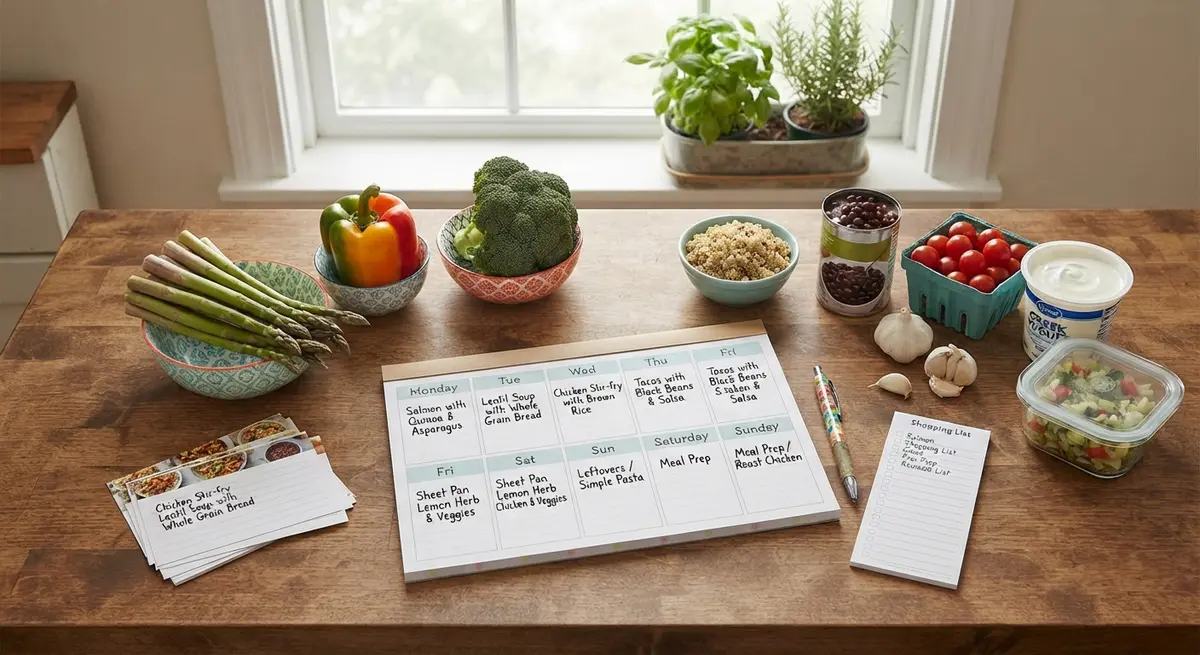
How to Build a Balanced Weekly Meal Plan Without Burnout
Meal planning without burnout: use the flexible 3-2-1 framework, a 20-minute Sunday session, and batch cooking tricks that survive real life.

How to Build a Morning Routine That Gives You Real Energy
A morning routine built for real energy, not Instagram: light, movement, hydration, and a steady breakfast that carry you past the midday slump.

Road Trip Snacks: Healthy and Satisfying Options for Long Drives
Forget gas-station despair. Here is the four-pillar snack formula, ten make-ahead road trip snacks, and a cooler that survives a 14-hour drive.

How to Set Up a Stylish and Functional Coffee Bar at Home
A perfect pour at 7 a.m. shouldn't require a hunt for the grinder. With the right gear, a tidy layout, and beautiful storage, your coffee corner becomes the best room in the house.
About the Authors
This recipe and guide was developed, tested, and approved in our home kitchen and daily life. Jamy is a retired Food Service District Manager and Early Childhood Program Manager who spent his career overseeing multi-site restaurant operations, large-scale culinary production, and daycare menu management. Kaïna brings the ultimate real-world test: making sure it brings ease and joy to our kids on a busy weeknight.
Read more about our professional background and philosophy →