Bone Broth Infused with Fresh Ginger, Garlic, and Star Anise
By the QuiteRecipes team (Jamy & Kaïna) | Food Service Professional, Early Childhood Expert & Parents
Good bone broth, quietly elevated — ginger, garlic and star anise steep in each cup for glycine, proline and warming circulation in a mug that heals on the inside.
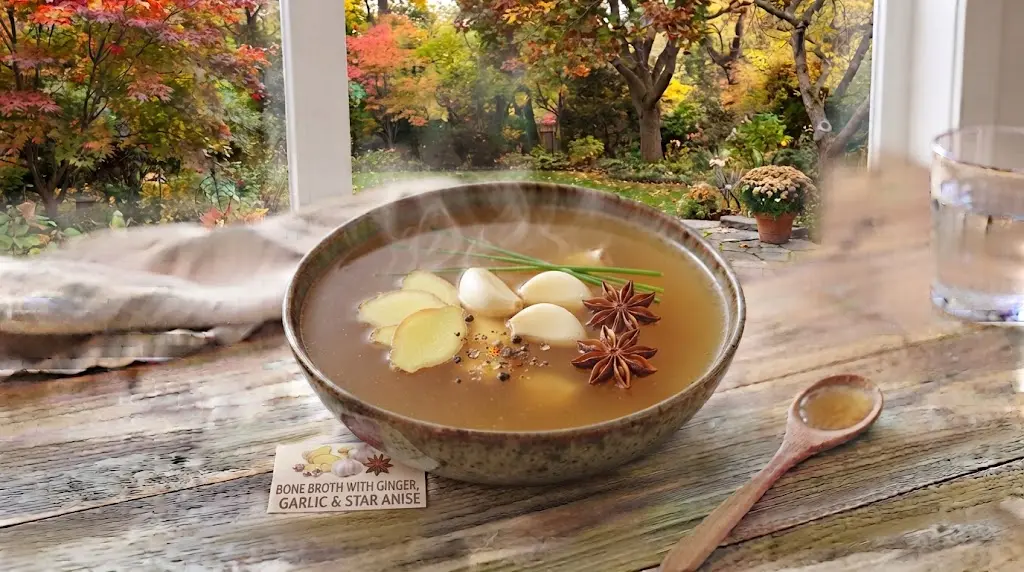
Bone broth is the original slow food, and this is the version that takes a good thing and seasons it toward comfort. A quality grass-fed broth reheats into a mug of rich, slightly jellied warmth whose glycine and proline are quiet workhorses for tissue repair — collagen's building blocks, the same architecture behind connective tissue and skin resilience. Into that base, fresh ginger, crushed garlic, and a single whole star anise steep like tea, turning the drink into a warming, circulatory tonic that belongs in the evening rotation, especially when the weather turns or your body asks for a reset. Fifteen minutes, and a warmel that fixes more than dinner.
🥄 Ingredients
- 🫗 3 cups quality grass-fed bone broth
- 🫗 3 thin slices fresh ginger
- 🫗 3 garlic cloves, crushed (not minced)
- 🫗 2 whole star anise
- 🫗 1/2 teaspoon black peppercorns
- 🫗 A squeeze of lemon (to finish)
- 🫗 Fine sea salt, to taste
Nutrition Facts*
*Nutritional information is an estimate and may vary based on ingredients, brands and portion sizes. Values are provided per serving.
👨🍳 Instructions
Warm the bone broth in a saucepan over medium heat until steaming but not boiling.
Add the ginger, crushed garlic, star anise, and peppercorns; reduce to a low simmer, cover, and steep 8–10 minutes.
Taste — the aromatics should be present but never shouting.
Strain into two mugs, finish with a squeeze of lemon and a pinch of salt, and sip warm.
⚠️ Common Mistakes
- ✕
Salting before the aromatics steep — then adjusting again and oversalting twice.
- ✕
Adding a whole star anise's siblings; one pod is a whisper of sweetness, three is cough-syrup.
- ✕
Using a bone broth so bland it needs more than seasoning — quality first, infusion second.
🔄 Variations
Add a shiitake mushroom cap with the aromatics for umami depth.
Spoon a teaspoon of miso into the hot mug for a brothy-spicy finish.
Serve over a nest of rice noodles for a full winter bowl.
A pinch of chili flakes turns the warming up a notch for cold evenings.
🧊 Storage
- 📦
The finished broth keeps 3 days in the fridge, or freeze in mug portions for 3 months.
- 📦
The aromatics' flavor fades fast — infuse fresh each time you reheat.
💡 Chef Tips
Tip 1: Crush, don't mince, the garlic — crushed cloves release their oils without muddying the broth.
Tip 2: Steep, don't boil; a rolling boil turns the aromatics bitter and the broth cloudy.
Tip 3: A splash of lemon at the end wakes up all the depth the bones spent hours building.
❓ FAQ
Q
What's actually in bone broth worth caring about? Glycine, proline, and collagen-building amino acids from the connective tissue, plus minerals that simmer out of the bones — real but modest, best viewed as a nourishing food, not a medicine.
Q
Why star anise? A single pod lends a warm, licorice-like sweetness that makes the broth feel like a restorative tonic — and tradition gives it a long history in warming winter drinks.
Q
Does ginger and garlic really "stimulate circulation"? Both are gently warming and traditionally circulatory-friendly; the hot mug itself is doing the honest work of directing blood flow toward your core.
Q
Can I drink this daily? A cup a day is a fine, comforting habit for most people — just watch the sodium if blood pressure is on your mind, and let your body's answer be the guide.
🔗 Related Recipes

About the Authors
This recipe and guide was developed, tested, and approved in our home kitchen and daily life. Jamy is a retired Food Service District Manager and Early Childhood Program Manager who spent his career overseeing multi-site restaurant operations, large-scale culinary production, and daycare menu management. Kaïna brings the ultimate real-world test: making sure it brings ease and joy to our kids on a busy weeknight.
Read more about our professional background and philosophy →